EU Regulation on Deforestation-free Products (EUDR)
Tilkal - Tilkal - The EU Regulation on Deforestation-free Products (EUDR) requires operators to prove that 7 commodities and their derivatives are not associated with deforestation, forest degradation, or breaches of local environmental and social laws.
[Updated August 26, 2026]
What. Minimizing the risk of deforestation, forest degradation and associated impacts on indigenous people in relation with products flowing into and out of the EU.
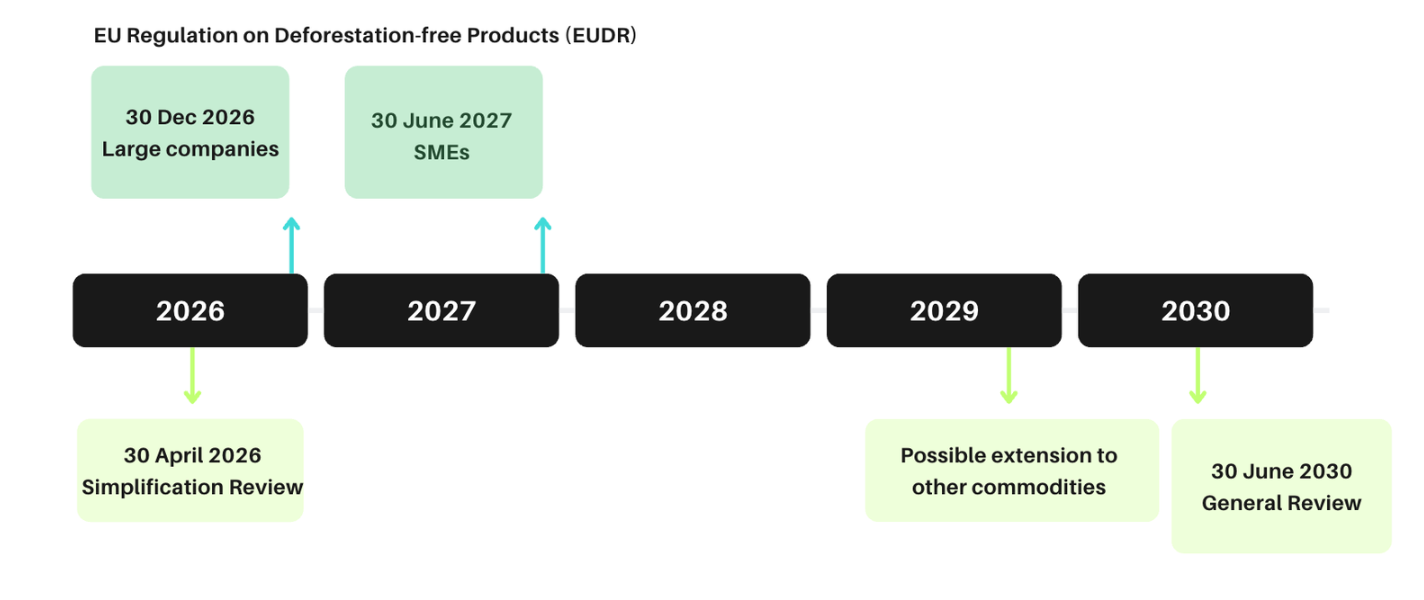
When. In force since 29th June 2023 and applicable starting 30th December 2026 for large companies (30th June 2027 for SMEs).
Products. Soy, cattle, palm oil, wood, cocoa, coffee, rubber, and some of their derived products, such as palm oil soap, chocolate, tires, or furniture.
Who. Companies involved in importing, exporting, and placing products in the EU.
Overview
The law seeks to drastically reduce the EU's contribution to deforestation and forest degradation, decrease carbon emissions and biodiversity loss caused by production and consumption, minimize consumption of products from supply chains associated with deforestation - and increase EU demand for and trade in legal and 'deforestation-free' commodities and derivatives.
It lays down rules regarding the import, placement and export of products that contain, have been fed with, or have been made using seven commodities: namely cattle, cocoa, coffee, palm oil, rubber, soya, and wood. Some of their derived products, such as instant coffee, chocolate, tires, paper, carton or furniture are also in scope.
How does the regulation work?
- Companies confirm to national authorities that the products they place on the market follow EU rules by submitting Due Diligence Statements (DDS) on the official EU Traces digital platform.
- A country benchmarking system conducted by the European Commission determines the risk of deforestation, which impacts the operator's obligations.
- Anonymized data of the system will be available to the broader public to foster transparency.
Main expectations
EUDR is about traceability, data quality, and risk intelligence. Companies (First Operators - see below) are expected to:
- Collect relevant traceability information about commodities and products to ensure they have not been produced on land deforested or degraded after December 31st 2020.
- Exercise mandatory due diligence, analyze and evaluate risks in their supply chain.
- Consult indigenous peoples, local communities, and other customary tenure rights holders or the respective civil society organisations that are present in the area of production of the relevant commodities and products, where applicable.
- Take adequate and proportionate mitigation measures, such as using satellite monitoring tools, field audits, capacity building of suppliers, or isotope testing to check the product's origin.
Latest developments
In May 2026, the European Parliament and the EU Council adopted targeted amendments to the EU Deforestation Regulation.
With the final text now published, companies finally have a clearer view of how the regulation will apply — and when.
1) First Operators
First operators are companies placing relevant products on the EU market for the first time.
If you are a first operator, you are expected to:
- trace raw materials back to plot-level origin (geolocation coordinates),
- conduct risk assessment and demonstrate that no deforestation has occurred after 2020,
- link each shipment and/or batch to geolocation data, legality documents, a risk assessment,
- and submit DDS information via the EU TRACES system before placing products on the EU market or exporting them.
2) Downstream Operators
Companies who purchase imported goods from, manufacture in, export from, or trade in the EU.
First downstream operators - operators buying from a First Operator - only must collect and store for 5 years the initial DDS reference numbers. If an operator knows his supplier is an upstream operator and no DDS was provided, he must refrain from placing or making the product available until he get the DDS. First downstream operators are also expected to verify the collected DDS in case of substantiated concerns.
3) Small & Micro Primary Operators
Operators which are micro or small enterprises producing and first placing on the market their own products.
Small & Micro Primary Operators sourcing from low-risk countries benefit from simplified declarations: they are required to submit a one-time simplified declaration in the information system. They are also allowed to replace the geolocation of plots of land by the postal address of the plots of land or of the establishment from where the relevant commodities that the relevant product contains, or has been made using, were produced.
What’s at risk for your company?
In due course, the intention is for breaches of the EUDR to lead to criminal penalties, but under the EUDR itself, penalties may include:
- Fines proportionate to the environmental damage and value of the items (it will gradually increase with repeated infringements) with a maximum of at least 4% of EU turnover in the preceding year and may be increased to exceed the potential economic benefit;
- Confiscation of the covered products or confiscation of the revenues gained from the items;
- Temporary exclusion from public procurement processes and public funding;
- For serious or repeated infringements, temporary prohibition from dealing in the EU in those items, or a prohibition from using the simplified due diligence process.
- "Name & Shame": reputational impact threat is real.